
Key Takeaways
- Ireland's tight-knit community is your greatest asset, PHN recommendations, Rollercoaster.ie forums and maternity hospital noticeboards connect you to trusted photographers that no directory can match
- 6 non-negotiables before booking: safety training, insurance, a genuine portfolio, rigorous hygiene, personal chemistry and full pricing transparency
- Typical costs in Ireland: €220–350 for a studio newborn session, €180–300 at home, €12–15 for passport photos
- Book 2–3 months before your due date, Ireland's best newborn photographers fill quickly, especially in Dublin, Cork and Galway
- The sweet spot for newborn posing is 5–12 days old, after that, the natural flexibility that makes those curled, sleepy poses possible starts to fade
Why choosing a baby photographer in Ireland is different, and easier than you think
Here's something that surprises many parents discovering the Irish photography scene for the first time: Ireland operates like a large village. Word travels fast. The photographer who captured your neighbour's baby last spring, whose prints are still framed above the fireplace, is almost certainly someone another parent in your PHN group raved about last week. Reputation moves through this community with a speed and intimacy that simply doesn't exist in larger markets.
That's genuinely good news for you. It means the noise-to-signal ratio is far lower here than in, say, the UK market at large. When a photographer in Ireland builds a strong name, everyone seems to know about it. And when someone has had a bad experience, that tends to travel just as quickly. Community accountability is built in.
That said, the Irish market has grown considerably in the past decade. The options can still feel overwhelming, particularly in Dublin, where the choice of specialist newborn photographers has expanded dramatically. So this guide exists to help you cut through the clutter: where to look first, what to look for when you find someone, how much to expect to pay, and how to recognise the handful of red flags that should send you looking elsewhere.
Whether you're in Dublin, Cork, Galway, Limerick or Waterford, or anywhere between, this is the complete guide to finding the right baby photographer for your family in Ireland in 2026.
Where to find a baby photographer in Ireland, start with community, not Google
This is advice you won't find in most generic photography guides, but it's the single most important thing to understand about the Irish market: the best photographers here are rarely found first through a Google search. They're found through the channels where Irish parents actually talk to each other, and those conversations are worth ten times more than any search result.
Here's where to begin.
Your Public Health Nurse (PHN)
Your PHN visits you at home in the weeks after your baby is born as part of the HSE's postnatal support programme. PHNs meet dozens of new families every month, and they see, literally, the photos on the walls and the albums on the coffee tables. Ask yours if they've heard of photographers with a particularly strong reputation in your area. This is an underused goldmine. PHNs tend to know which photographers parents genuinely rave about versus those who are simply well-marketed.
Your antenatal or parent group
NCT Ireland groups (National Childbirth Trust) bring together parents at similar stages of pregnancy and new parenthood, and the photography discussion that inevitably breaks out in every WhatsApp group is usually the most reliable research you'll do. Parents who've had sessions recently are happy to share their experiences, show you actual photos and tell you honestly what the process felt like. Ask specifically about photographers from your county or city, commuting with a newborn is not something anyone wants to do unnecessarily.
Rollercoaster.ie
Ireland's largest parenting community website, Rollercoaster.ie, has been the go-to forum for Irish parents for well over a decade. The forums contain thousands of threads on baby photography, searches for your county or city will surface years of genuine parent recommendations, photographers tagged by location, and candid accounts of what various studios are actually like. Unlike Google reviews, which photographers can manage and respond to, forum threads tend to be unfiltered and detailed.
Maternity hospital noticeboards
The noticeboards at the Rotunda Hospital and National Maternity Hospital (Holles Street) in Dublin, CUMH (Cork University Maternity Hospital), and UHG (Galway) are deliberately curated spaces. Maternity hospitals are cautious about which photographers they allow to advertise, which effectively means any card on that board has already cleared an informal vetting process. It's a useful first filter, particularly for parents in those cities.
Facebook community groups
Local Facebook parenting groups, "Mums of [County]", "Dublin Babies & Toddlers", "Cork Mums" and their equivalents, are active and responsive. Post a simple question asking for recommendations, specify your area and roughly when you're due, and you'll typically have 15–20 replies within a few hours. The responses will include photographers' names, sample photos shared by happy parents and the kind of nuanced feedback ("she was so patient when Aoife wouldn't settle") that you simply can't get from a formal review platform.
Instagram and online discovery
Once community channels have given you a shortlist of names, Instagram is your best tool for going deeper on portfolio quality. Search hashtags like #newbornphotographyireland, #dublinbabyphotographer, #corknewborn or #galwaybabyphotographer. Most Irish photographers are active on Instagram and post regularly, so you'll quickly get a sense of their current style, consistency and output quality.
You can also browse our directory of baby photographers across Ireland to compare profiles, locations and specialisms side by side.
Professional associations
The IPPVA (Irish Professional Photographers & Videographers Association) maintains a searchable directory of Irish photographers who have committed to professional standards and ongoing development. Membership isn't a guarantee of the right fit for your family, but it's a meaningful signal that you're dealing with someone serious about their craft, and it provides a point of recourse if something goes wrong.

The important thing to understand about all of these channels is that they are mutually reinforcing. A photographer who comes up repeatedly, in your PHN's conversation, on Rollercoaster.ie and in your NCT group, has earned that visibility through consistent work over time. That kind of reputation is genuinely harder to fake in a small, interconnected market than it is in a large anonymous one. Use it to your advantage.
Types of baby photo sessions in Ireland
Not all baby photo sessions are the same, and knowing which type you want before you start looking will sharpen your search considerably. Different sessions require different skills, different equipment and, in the case of newborn posing, specialist training that not every photographer has. Here's what you need to know about each.
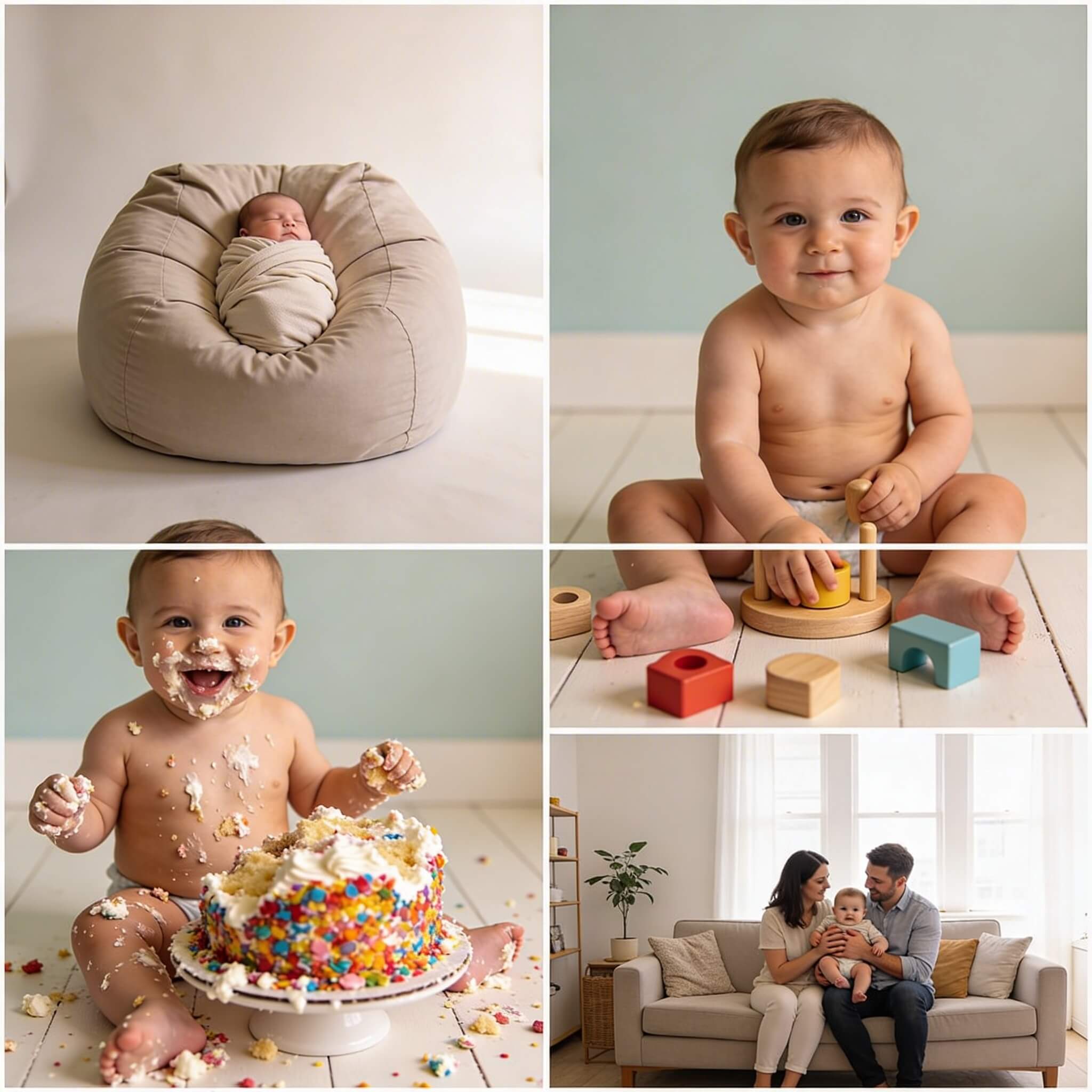
Newborn posing sessions (0–15 days): the window that closes fast
Newborn posing photography is the most technically demanding, and the most time-sensitive, baby photography specialism. The ideal window is between day 5 and day 12 of your baby's life. During this period, newborns retain their natural flexibility: the tight curls, the foetal positions, the deep sleeps between feeds that allow a skilled photographer to create those iconic, breathtaking images. After around day 15, that window begins to close as babies grow quickly and become more alert and reactive.
A proper newborn posing session typically takes 2.5 to 4 hours. That's not padding, it's a genuine requirement. Your baby will dictate every single break: feeds (breastfeeding or bottle), nappy changes, unsettled spells, wind, simply needing to be held. An experienced photographer builds all of this into their schedule and never rushes. The studio should be maintained at around 26–28°C so your baby remains comfortable throughout, the same temperature as being held in warm arms.
The techniques involved, safe foetal curls, gentle wrapping, composite poses, require specific professional training. This is not a category you want to compromise on for price. We'll return to this point in the non-negotiables section.
3–6 month sessions: all the smiles, none of the waiting
By three months, most Irish babies have found their smiles and are beginning to engage actively with the world around them. These sessions are joyful, spontaneous and technically far less demanding for the photographer. Your baby lies on their back or tummy, head control is developing but sitting independently is still a few months away, and the photographer works with natural expressions, light and simple props. Sessions typically run 30–45 minutes. This is a brilliant option for parents who missed the newborn window or want to add a second milestone session to their collection.
Sitting baby sessions (6–9 months): personality has arrived
Once your baby is sitting confidently, the creative possibilities multiply considerably. Textured blankets, decorated baskets, simple wooden letters spelling out their name, balloons, hats, props become genuinely fun at this stage because your baby can interact with them. These sessions last roughly 45 minutes to an hour and tend to produce the most varied galleries, since the photographer can move between close-up expressions, environmental shots and playful setups. If there's one session that guarantees pure joy in the photos, it's probably this one.
First birthday, the Smash the Cake session
There's a reason this session has become a fixture in Irish family photography. Watching a one-year-old encounter a beautifully decorated birthday cake for the first time, the tentative first touch, the discovery, the gleeful destruction, produces photographs of extraordinary expressiveness. Many photographers in Ireland end the session with a warm bath, resulting in some of the most tender images in the whole first-year collection. Budget 1 to 1.5 hours and expect to bring a change of clothes for everyone in the room.
Passport photos: a practical but technical challenge
Baby passport photos for the Irish Passport Service (Department of Foreign Affairs) must comply with very specific requirements: a plain cream or white background, the baby's face forward and clearly visible, eyes open and looking towards the camera, mouth closed, no accessories or headwear. With a newborn, this is a genuine technical challenge, but photographers who specialise in babies have developed reliable techniques for achieving compliant images quickly. Expect a 15–20 minute session and costs of €10–15. Always check the current specifications on the Irish Passport Service website before your appointment, as requirements do update periodically.
| Session type | Ideal age | Duration | What makes it special |
|---|---|---|---|
| Newborn posing | 5–12 days | 2.5–4 hours | Curled poses, deep sleep, specialist training essential |
| 3–6 months | 3–6 months | 30–45 min | First real smiles, spontaneous expressions, light props |
| Sitting baby | 6–9 months | 45 min–1 hour | Personality on full display, varied setups possible |
| Smash the Cake | 12 months | 1–1.5 hours | Pure joy, optional bath sequence, themed decoration |
| Passport photos | From birth | 15–20 min | Compliant with Irish Passport Service requirements |
Family sessions including baby
Many families choose to book a session that includes siblings, parents and grandparents alongside the baby. These can work beautifully either in a studio or at a favourite outdoor location, a beach, a park, a family farm. Irish photographers who offer this format tend to describe it as documentary-style: they're capturing genuine interactions rather than posed arrangements. The emphasis is on what your family actually looks like together, right now. These sessions last approximately an hour and produce a gallery that tells a wider story than a baby-only shoot.
Studio posing vs. lifestyle at home: which suits your family?
Beyond the type of session you choose, there's a more fundamental stylistic question to resolve: do you want the controlled artistry of a dedicated studio, or the warm authenticity of your own home? These are genuinely different experiences, and the right answer depends entirely on what you want the images to feel like.
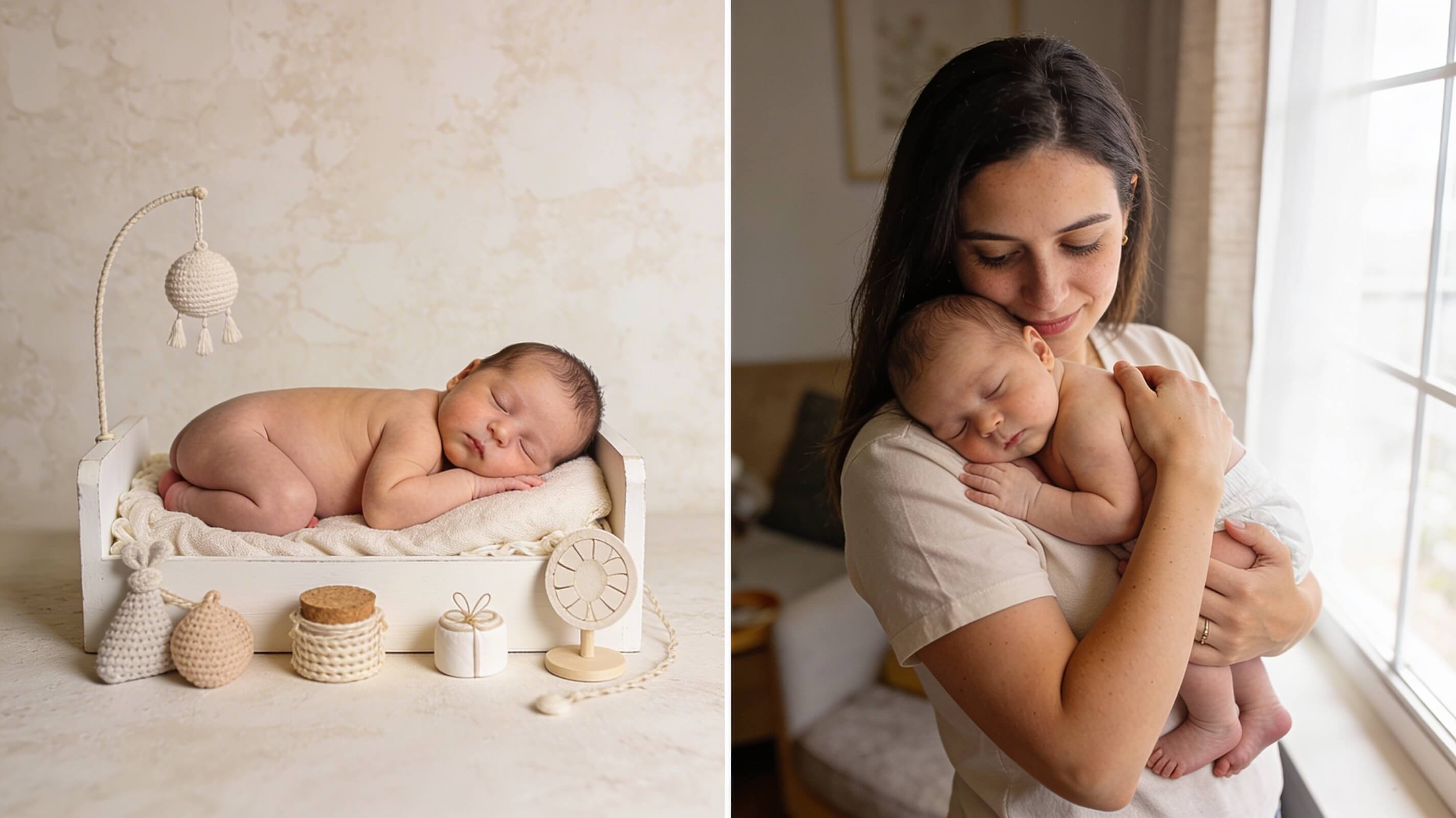
Studio sessions take place in the photographer's dedicated space, where every variable, lighting, temperature, backdrops, props, is precisely controlled. The result is a polished, editorial aesthetic: images that look beautiful printed large and hung on a wall, that feel timeless because they exist outside of any particular home or setting. The trade-off is that you're travelling to the studio with a newborn, which some parents find stressful in the very early days.
Lifestyle sessions at home work in the opposite direction. The photographer comes to you, no travel, no unfamiliar environment, and documents your baby in the context of your own family life. The cot they'll sleep in for the next year, the sofa where you've spent every feeding night, the light through your bedroom window at 8am. The images feel intimate and specific to your story in a way that studio photos simply can't replicate. They're not less technically accomplished, a skilled lifestyle photographer reads available light and domestic environments with tremendous skill, they're just differently oriented. You can learn more about home newborn sessions and how to prepare your space on our tips page.
Both approaches are well represented in the Irish market, across all price points. The simplest way to decide is to look at a photographer's portfolio and notice your own reaction: does the polished studio work make you want to book immediately, or are you more drawn to the warm, real-life images from someone's actual home? Trust that instinct, it's the right one for your family.
It's also worth understanding the role of post-processing in both styles. A studio photographer may spend considerable time on colour grading, subtle skin retouching and the creation of safety composites, images where two or more shots are merged in post-production to create poses that appear to be achieved without hand support. Your baby is always fully supported throughout; the composite is purely a post-processing step. If you're curious about what this process involves, Adobe's overview of newborn photography techniques explains the craft clearly.
Budget and pricing in Ireland: what to expect
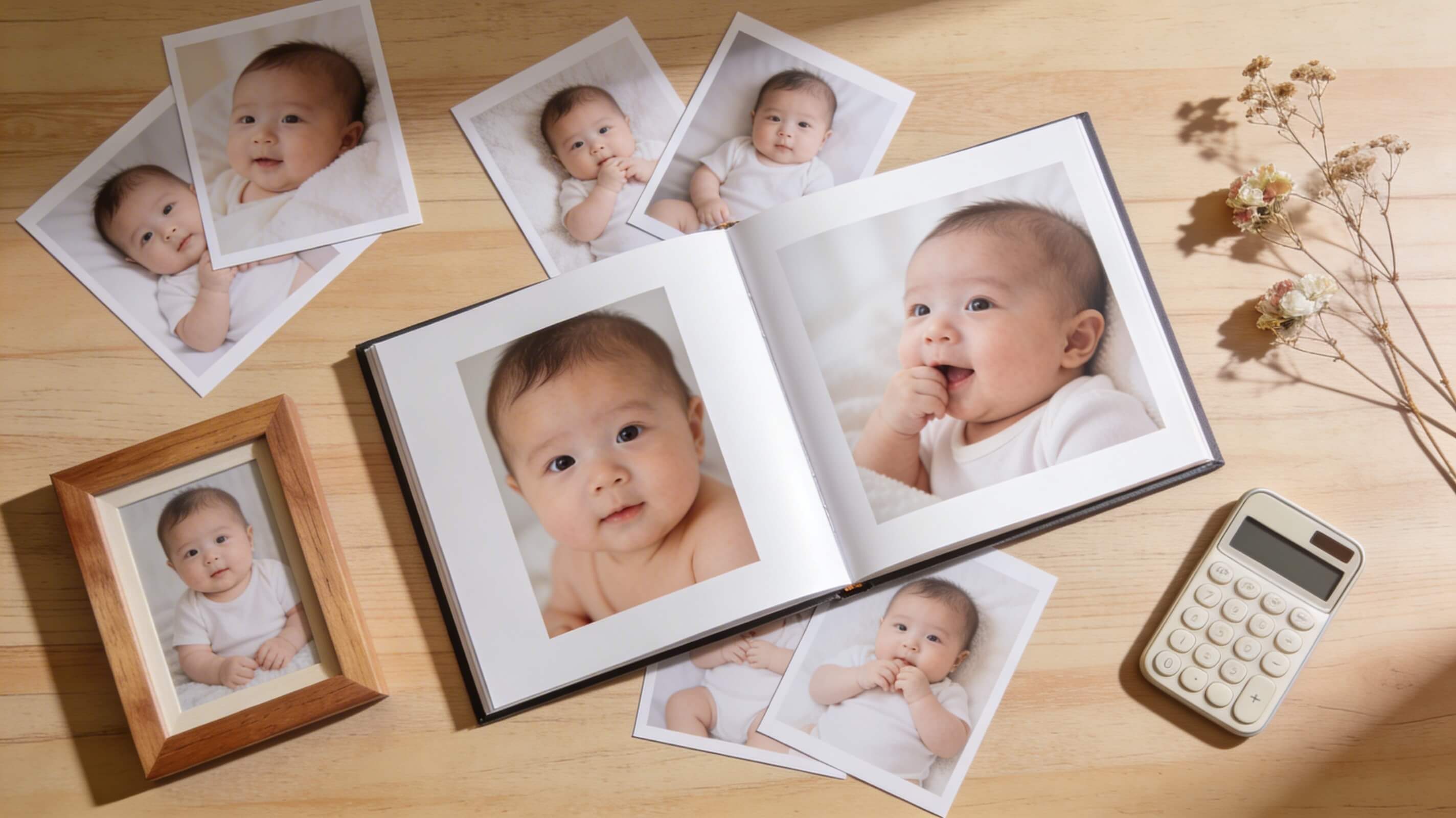
Irish photography pricing has matured considerably in the past few years. Rates reflect both the genuine skill and training involved and the real costs of running a professional studio, insurance, equipment, heating (and in Ireland's climate, that last one is not trivial). Here's what you should expect to pay across different session types and budget levels.
| Session type | Starting from | Typical range | Premium |
|---|---|---|---|
| Newborn in studio | €150 | €220–350 | €500+ |
| Newborn at home | €120 | €180–300 | €400+ |
| Baby 3–9 months | €100 | €160–250 | €350 |
| Smash the Cake (1 year) | €150 | €200–280 | €380 |
| Passport photos | €10 | €12–15 | €20 |
A few things worth understanding about how Irish photographers structure their pricing:
Session fee vs. all-inclusive packages: Some photographers charge a session fee (covering their time and expertise) separately from the cost of digital files, prints and albums. Others offer all-inclusive packages where everything is bundled. Neither model is inherently better, but you must understand which one you're looking at before comparing prices. A €120 session fee that then charges €40 per digital file is not necessarily better value than a €280 all-inclusive package.
Dublin vs. the rest of the country: Dublin photographers, particularly those in south Dublin and Wicklow, tend to sit at the higher end of the typical ranges above. Photographers based in Cork, Galway and Limerick are often 15–20% more affordable for equivalent quality and experience. If you're based near a city boundary, it's worth looking at photographers from neighbouring counties as well.
Multi-session packages: Several Irish photographers offer milestone bundles covering two or three sessions, for example, a newborn session plus a six-month sitting and a first birthday Smash the Cake. Booking all three together typically saves 15–20% compared with booking each separately, and it gives you the continuity of working with the same photographer who already knows your baby.
A note on very low prices
- A full newborn studio session advertised at under €80 should be approached with caution
- At that price point, the photographer is unlikely to have invested in specialist newborn safety training, which costs several hundred euros and requires ongoing updating
- The delivered image count may be very low, or the images may be unedited
- Insurance, a non-negotiable for a professional handling your newborn, has a real annual cost that must be factored into pricing
- These photographs are the only record you will ever have of your baby at this age. They are worth a proportionate investment.
For the most current pricing from photographers in your area, browse our directory and request quotes from two or three specialists. The process of comparing proper quotes, with session details, image counts and delivery timelines clearly stated, is the fastest way to understand the true value on offer.
The 6 non-negotiables before you book
Ireland's photography community is predominantly professional, dedicated and safety-conscious. But with any market, especially one that's grown rapidly, the quality of practitioners varies. These six criteria are the minimum threshold you should apply before committing to any photographer, regardless of how appealing their Instagram feed looks or how enthusiastically they were recommended.
1. Specialist safety training in newborn handling
This is the single most important criterion, and it applies specifically to newborn posing sessions. A baby between 5 and 15 days old has a developing skeletal and muscular system, joints and soft tissues that respond very differently to those of an adult or even an older infant. The poses that make newborn photography so beautiful require a precise understanding of foetal physiology: which positions are natural and safe, which are composite images that must never be attempted as single-shot poses, how to recognise signs of discomfort or distress, and how to support a baby safely throughout a session lasting several hours.
This knowledge is not innate, and it is not acquired simply by photographing lots of babies. It requires formal training, either in-person workshops with established newborn photography educators or recognised online programmes. Ask every photographer you're considering: "What specific training have you completed in newborn safety and handling, and when did you last update it?" A trained photographer will answer this question fluently and with enthusiasm. They'll mention their mentors, the workshops they've attended, and they'll be glad you asked. Any evasion, deflection or vagueness here is a signal to look elsewhere, not just for a better photographer, but for a safer one.
2. Professional liability insurance
Every professional who handles your newborn in a commercial context should carry public liability insurance. This protects your family in the event of any incident during the session, however unlikely, and it signals that the photographer operates as a genuine professional rather than a casual enthusiast charging for their hobby. Do not feel uncomfortable asking for proof of insurance. Any legitimate professional will provide this without hesitation. If a photographer becomes defensive or evasive when you raise the subject, the absence of insurance is almost certainly the reason why.
3. A genuine, deep portfolio, not a highlight reel
Every photographer has a highlight reel: their ten best images, the ones that make the portfolio page glow. What you want to see is more than that. Ask to view complete galleries from three or four recent newborn sessions, the kind of gallery you'd actually receive after booking. This tells you far more than cherry-picked hero shots. Look for consistency of quality across a full gallery: are the images strong throughout, or do five excellent shots surround forty mediocre ones? Are the babies consistently comfortable-looking? Does the lighting hold up across different skin tones and at different times of day? Is the style consistent, or does it feel like different photographers worked on different sessions?
Also look for recency. A photographer's portfolio from two or three years ago doesn't tell you what they're producing today, styles evolve, skills improve (or decline), and equipment changes. You want to see work from within the last six to twelve months.
4. Hygiene standards that are clearly documented and practised
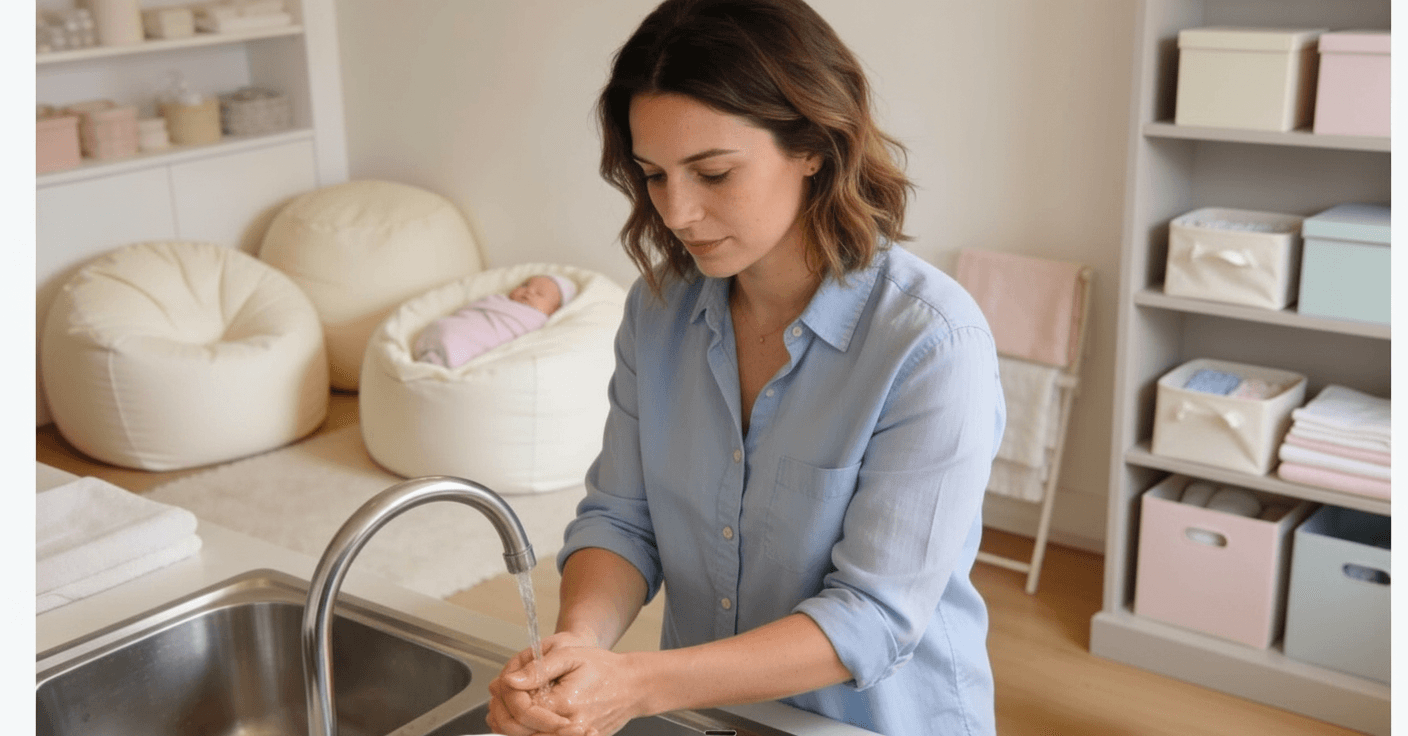
A newborn baby has an immune system that is still developing rapidly. The studio environment, every prop, every wrap, every surface that comes into contact with your baby must be properly sanitised between sessions. A conscientious photographer will tell you about their hygiene protocol without being asked: how they clean their props, at what temperature they wash their textiles, that they always reschedule their own sessions when they are unwell, and that they ask parents to notify them if their family is sick in the days before the appointment. If you have to drag this information out of them, it may be because the protocol is less thorough than it should be. You are entitled to ask, and a professional will welcome the question.
5. The right personal chemistry
You will spend between two and four hours with your newborn photographer during one of the most intimate and emotionally charged experiences of your early parenthood. The rapport matters, not just for your comfort, but for the quality of the images. A nervous, uncomfortable parent communicates that tension in every photograph. When a photographer makes you feel genuinely relaxed, seen and supported, it shows in the work.
Before booking, have a proper conversation, by phone if at all possible, not just email. Notice whether the photographer listens actively, asks questions about your preferences, and speaks about safety and baby wellbeing with obvious fluency and care. Notice also whether you come away from the conversation feeling excited or slightly uneasy. Trust the latter instinct as strongly as you trust the former.
6. Complete pricing transparency, in writing
A professional photographer presents their pricing clearly and comprehensively before you book: what the session includes, how many edited images you'll receive, in what format they're delivered, how quickly after the session, whether you have full print rights, what their cancellation policy is, and what happens if your baby arrives significantly early or late. No ambiguity, no "we'll discuss the rest when you arrive", no surprises. If any of this information is withheld or vague during the enquiry process, be cautious, in the Irish consumer market, hidden costs in photography packages are an occasional but real issue. Everything should be in writing before any deposit changes hands.
Questions to ask before you commit
Once you've shortlisted two or three photographers who meet all six non-negotiables, this is the stage at which the decision gets personal. The following questions are designed to help you evaluate experience, working style and fit, and to surface any issues before they become problems.
Questions about their newborn experience
- "Roughly how many newborn sessions have you completed in total, and how many per year currently?", A photographer doing 20–30+ newborn sessions annually has encountered the full range of situations: unsettled babies, complicated births, premature arrivals, multiples. That breadth of experience matters.
- "Do you work with an assistant during sessions?", For composite poses and to help manage long sessions safely, an assistant is important. Find out whether this is standard or optional.
- "How do you handle a session when a baby is very unsettled and resistant to posing?", The answer tells you a lot about their temperament and their baby-first philosophy. A good answer involves patience, adaptation and no pressure to achieve any particular image at the expense of the baby's comfort.
- "Can I see your most recent complete gallery, not just your portfolio highlights?"
Questions about the practical details
- "What temperature do you keep your studio at, and how do you heat it during a session?"
- "What is your process if either of us needs to cancel or reschedule, particularly if my baby arrives earlier or later than expected?"
- "How long after the session can I expect to receive my gallery?", Typical turnaround in Ireland is 2–5 weeks for a fully edited newborn gallery.
- "Do you have a contingency plan if you become ill on the day of the session?", This is more common than people expect. A professional will have a trusted colleague they can call on.
- "Are there any props or setups I should specifically request in advance?"
Questions about what you'll receive
- "How many edited images are included in this package, and what is the process if I want additional images?"
- "Are the digital files delivered at full resolution, and do I have unlimited personal print rights?"
- "Do you offer printed products, albums, wall art, framed prints, and are these included or priced separately?"
- "In what format are galleries delivered, online proofing gallery, USB, downloadable link?"
Questions about rights and administration
- "Can I share the images on social media, and under what conditions?"
- "Do you use client images for portfolio or marketing purposes, and how do I opt out if I prefer privacy?", Particularly relevant in Ireland, where community is tight and some parents prefer that studio samples from their session aren't circulated publicly.
- "What deposit do you require, when is the balance due, and what does your contract cover?"
Our tip: call, don't just email
- A back-and-forth email thread is an inefficient way to evaluate a photographer
- A 15–20 minute phone call gives you far more: tone of voice, how they handle questions, whether they listen or just sell
- If a photographer is reluctant to get on a call before you book, that tells you something important about their communication style, and you'll be spending hours with them very soon
5 warning signs to watch out for
Ireland's photography community polices itself reasonably well, word travels fast here, and photographers who provide a poor experience tend to find that their reputation suffers quickly. But here are five specific warning signs that should prompt you to pause and reconsider, regardless of how appealing a photographer's work looks on the surface.
1. No verifiable IPPVA membership or equivalent professional credentials
Not every excellent photographer in Ireland is an IPPVA member, membership is voluntary, not mandatory. But when a photographer has no verifiable professional affiliations of any kind, no insurance documentation they're willing to share, and no traceable professional history beyond their own social media accounts, the absence of credentials is meaningful. The IPPVA exists precisely to provide parents with a layer of assurance. A photographer who dismisses professional association membership as "just a badge" while being unwilling to substantiate their credentials in any other way deserves scrutiny.
2. Composite poses presented as single-shot images
Some of the most iconic newborn images, a baby appearing to sit unassisted in cupped hands, a newborn balanced on the edge of a prop with no visible support, are safety composites: multiple images merged in post-production, with an assistant's hands supporting the baby throughout every single frame. This is standard professional practice and entirely safe. What is not safe is any photographer who claims to achieve these images in a single unsupported shot. If a photographer either doesn't know what safety composites are, or asserts that they're unnecessary because "I'm very experienced", this is a hard stop. Move on.
3. Pricing that obscures the true total cost
This is the most common source of dissatisfaction in Irish photography reviews. A low session fee that conceals very high per-image costs, or a "full package" that doesn't include digital download rights, or surprise charges for basic editing that you assumed was included, these pricing structures are not honest. Before paying any deposit, you should be able to calculate the total cost of your session, including every image you'll receive in every format you want, with zero ambiguity. If a photographer can't, or won't, give you that total in writing before you book, assume the eventual cost will be higher than you expect.
4. Resistance to providing a written contract
A written agreement is a basic requirement of any professional commercial transaction involving your newborn. It should cover the session date, the location, the package details, the deposit paid, the balance due and the due date, the delivery timeline, the cancellation terms for both parties, and what happens if the photographer cannot fulfil the booking. Any photographer who expresses reluctance to provide a formal contract, citing informality, trust, or "we just sort it out between us"is leaving you without recourse if things go wrong. The Irish consumer protection framework is clear on this, and a professional photographer has no legitimate reason to avoid a contract.
5. Pressure tactics around booking urgency
The newborn window is genuinely time-sensitive, this is a real fact, not a sales technique. But there is a meaningful difference between a photographer explaining calmly that they have limited availability in your target weeks and asking you to decide within 48 hours, versus a photographer who creates artificial urgency: "I have three enquiries for that week already", "this price increases at the end of the month", "if you don't pay today I'll have to release your slot." In a small market like Ireland's, word about high-pressure sales tactics gets around. Photographers with genuinely strong reputations don't need to operate this way. Take the time you need to make a thoughtful decision, it's your newborn, and the booking should happen at your pace.
Timing and planning: when to book and when to schedule the session
When to book
For a newborn posing session, the right time to start looking and enquiring is during your second trimester, ideally around weeks 20–24 of your pregnancy. This might feel very early, but here's the reality: specialist newborn photographers in Ireland, particularly those based in Dublin and Cork, regularly have waiting lists of 6–8 weeks or more. The combination of limited availability (most photographers cap their newborn bookings at 4–6 per month to maintain quality) and the narrow optimal window (days 5–12 of your baby's life) means that late enquiries frequently miss the boat entirely.
The standard process works like this: you enquire and discuss the session during your pregnancy, the photographer holds a 3–4 week flexible window around your due date, and once your baby arrives, you contact them within 24–48 hours to confirm the specific date. Most experienced newborn photographers are accustomed to this flexibility and have systems in place to manage it smoothly.
For milestone sessions (3 months, 6 months, first birthday), three to four weeks' notice is generally sufficient, though popular photographers in busy periods (before Christmas, spring) can book up faster than you'd expect.
When to schedule the actual session
For newborn posing, the optimal window is days 5 to 12 after birth. Day 5 is typically the earliest at which the baby has stabilised from the birth itself and is feeding with some regularity. By day 12, the natural foetal flexibility that enables curled posing positions is beginning to reduce. Within this window, days 7–10 are often considered the sweet spot by experienced Irish photographers.
Time of day matters more than many parents realise. For newborns, morning sessions tend to work best, babies are typically at their most settled after the first morning feed, and the morning light (if you're doing a lifestyle session) is often the softest and most flattering. Aim for a start time between 9am and 11am if you can.
For older babies, your own knowledge of their daily patterns is the best guide. Schedule sessions after a good nap and a full feed. Avoid sessions during known cranky periods. If your baby has a reliable "golden hour" of happiness and engagement every day, that's your session time.
Preparing for the day
The HSE's guidance on caring for your newborn is a useful reference for understanding your baby's comfort needs during the first weeks, a good context for thinking about what a session will feel like for them. Beyond that:
- Feed your baby in the 45–60 minutes before the session begins, but not so recently that wind is likely to be an issue
- Avoid clothing with tight cuffs or elasticated ankles in the days before, marks on delicate newborn skin can take several hours to fade
- Pack nappies, wipes, a dummy if your baby uses one, a comfort item and at least one change of clothes
- If you're coming to a studio, allow more travel time than you think you'll need, the combination of a newborn, a nappy bag and Irish traffic is reliably unpredictable
- Tell the photographer honestly if your baby has been unsettled or if you've had a difficult night, they need to know so they can adjust their expectations and approach
Frequently asked questions about baby photography in Ireland
Can I use an Irish baby photographer for passport photos, and what are the exact requirements?
Yes, and for newborns, a specialist baby photographer is by far the easiest way to obtain compliant passport photos. The Irish Passport Service requires that baby passport photos meet specific standards: a plain cream or white background, the baby's face fully visible and looking directly towards the camera, both eyes open, mouth closed, no shadows on the face or background, and the head straight without tilting. Accessories including hats and headbands are not permitted. With a newborn, achieving all of this simultaneously is genuinely difficult, babies move constantly, their eyes may not cooperate, and getting a neutral expression requires patience. A photographer who specialises in babies will typically have a reliable technique: lying the baby on a clean white blanket, using a portable reflector to eliminate shadows, and taking a rapid sequence of shots to capture the right combination. The Irish Passport Service periodically updates its photo specifications, so always verify the current requirements on the official website before your appointment. Expect to pay €10–15 for a compliant set of passport photos from a specialist.
My PHN mentioned a photographer she often recommends. Should I just book them without researching further?
A PHN recommendation is an excellent starting point, genuinely one of the most reliable signals you can have in the Irish market, because PHNs see the results of many different photographers' work in their clients' homes. But it's still worth doing a basic check before booking: look at the photographer's current portfolio (styles and quality can change), verify that they have insurance and can describe their newborn safety training clearly, and read recent Google or Facebook reviews to confirm the positive experience is consistent and recent. A PHN recommendation combined with a solid portfolio, clear insurance and good recent reviews is a very strong signal that you've found someone excellent. The recommendation alone, without verification, leaves a small gap. Spend 30 minutes closing it, you'll book with far greater confidence.
Is it possible to have a photo session at a maternity hospital, the Rotunda, Holles Street or CUMH?
In-hospital photography is a separate specialism from standard newborn posing or lifestyle photography. Some Irish maternity hospitals do facilitate professional photographers, either through formally approved arrangements or through informal access. The key distinction is that hospital photography typically captures the first hours of life, immediate skin-to-skin moments, the first holds, the very raw beginning. These sessions are documentary in nature rather than artistically posed. If in-hospital photography interests you, contact the communications or administration department of your specific hospital well in advance of your due date to understand what arrangements they permit. It's a different experience from a studio or home session, and the right choice depends on what kind of record you want of those earliest moments.
Are there good baby photographers outside Dublin? I'm in Galway and worried the choice will be limited.
Ireland's photography talent is distributed more evenly than many parents assume. Galway has a vibrant creative community and several highly regarded newborn specialists. Cork, Limerick and Waterford all have active baby photography scenes. The important thing to know is that many Irish photographers are willing to travel, most will cover a 30–45 minute radius from their base as standard, and some will travel further for lifestyle sessions. When you search the photographer directory or post in local Facebook groups, specify your county and ask explicitly about travel radius. You may find that a highly regarded photographer an hour away offers better value and a stronger portfolio than a closer but less experienced option. Don't restrict your search to your immediate town or suburb before checking what's available within a comfortable drive.
What should I do if my baby doesn't cooperate during the session and hardly any photos are taken?
This is rarer than you might fear, and a genuinely experienced newborn photographer has strategies for almost every situation, an unsettled baby, persistent wind, a feeding strike, a baby who simply refuses to sleep. Sessions are scheduled long specifically to accommodate interruptions and resets. That said, occasionally a session genuinely doesn't go well: a baby is going through a growth spurt or developmental leap, or is reacting to something in the environment. Most professional photographers in Ireland have a clear policy for this scenario, either a reduced charge for a session that produced minimal usable images, or a complimentary partial reshoot. Ask about this policy before you book. It should be included in your written contract. A photographer who has no policy for this eventuality, or who takes the position that all sales are final regardless of outcome, is not operating according to the standards of the Irish professional photography community.
How far in advance should I book a baby photographer in Ireland?
For newborn sessions: begin enquiring during your second trimester, around 20–24 weeks pregnant. This allows time to compare two or three photographers properly, have proper conversations, and secure a booking with the photographer who's the best fit, not just the first one with availability. Leaving it until your third trimester is still workable with most photographers, but popular specialists in Dublin and Cork can be fully booked months in advance, particularly in the spring and autumn busy seasons. For milestone sessions at 3 months, 6 months or 1 year, three to four weeks' advance notice is generally sufficient, though again, booking earlier gives you more choice over dates and timing.
Can I ask the photographer to sign an NDA or privacy agreement so my baby's photos won't appear on their social media or website?
Absolutely, and this is a perfectly reasonable request. Irish data protection legislation (the GDPR as enacted in Irish law) gives you clear rights over the use of your children's images in commercial contexts. Most professional photographers in Ireland include a consent section in their standard client agreement covering portfolio use, social media sharing and website display. If you prefer full privacy, which some parents do, for entirely understandable reasons, simply state this when you make your enquiry and ask that the contract reflects it explicitly. A professional photographer will accommodate this without difficulty. It's also worth clarifying whether the photographer's assistant or any visitor to the studio during your session would have access to your images, particularly if you're working with a photographer who runs workshops or mentoring sessions from their studio.
Is a lifestyle session at home really as good as a studio session, or is it a budget compromise?
It's not a budget compromise, it's a genuinely different product that many families prefer regardless of cost. Lifestyle photography at home requires its own set of skills: reading available light in unfamiliar domestic spaces, working within the constraints of real rooms rather than a controlled studio, capturing authentic moments rather than constructed ones. A skilled lifestyle photographer will assess your home's light before the session, identify the best rooms and angles, and work within your space in a way that makes the images feel both beautiful and true. The resulting gallery will look different from a studio portfolio, warmer, more specific, more obviously yours. Whether that's better or worse depends entirely on what you want the images to feel like in 20 years. Both options are represented at every price point in the Irish market, so the choice doesn't have to be driven by budget.
What should I look for in an Irish baby photographer's online reviews?
The most useful reviews are the ones that are specific rather than generic. "Amazing photos, highly recommend!" tells you very little. "She let us take three feeding breaks without any pressure, the studio was incredibly warm and Séan settled within ten minutes" tells you a great deal. When reading reviews for Irish photographers, prioritise those that mention: how the photographer handled an unsettled or difficult baby, how clearly the pricing and package details were communicated in advance, whether the delivered images matched the portfolio quality, how responsive the photographer was between booking and session day, and whether the turnaround time for the finished gallery matched what was promised. Also look at how recently the reviews were written, a string of excellent reviews from three years ago and nothing since can indicate a change in quality or operating style. For Irish-specific platforms, check Google Business profiles, Facebook page recommendations and any mentions on Rollercoaster.ie forums, which tend to be more candid and detailed than formal review platforms. You can also visit our FAQ section for more guidance on evaluating photographers.
What happens to my booking if the photographer becomes unavailable, illness, family emergency, equipment failure, on the day of the session?
This is a scenario that parents rarely consider when booking, but it matters, particularly for a newborn session, where rescheduling even by a week may take you outside the optimal posing window. Before you pay any deposit, ask the photographer directly: "What is your contingency plan if you cannot make the session?" A professional answer typically involves a named colleague or fellow photographer they would contact to cover the session at the same quality level, or a clear rescheduling policy that accounts for the time-sensitivity of a newborn session, including the possibility of a partial refund if the rescheduled date falls outside the optimal window. If a photographer has no plan for this situation and simply says "it won't happen", that's not a reassuring answer, it's an unrealistic one. Equipment failure, illness and family emergencies happen to everyone. A professional has a plan for when they do.

