

What you need to know at a glance
- Timing is everything: schedule your session right after a feed and a full sleep, a contented baby makes the photographer's job possible and the results magical
- Every age demands a different approach: newborn curled poses only work in the first 10–15 days; by 6–8 months the real creative possibilities open up
- A north-facing window is worth more than any studio light: place your baby 1–2 metres away at a 45° angle for naturally soft, flattering results
- Camera mode matters: aperture priority (f/1.8–f/2.8) with a shutter speed no slower than 1/125s keeps those fleeting expressions sharp
- Safety is non-negotiable: head and neck support at all times, room temperature at 24–28°C for undressed newborns, and never a posed shot without an adult within arm's reach
Why baby photography is unlike any other genre
There's a reason professional baby photographers train specifically for this work, it's one of the most technically and emotionally demanding genres in portraiture. Your baby moves without warning, operates entirely on their own schedule, and passes through developmental stages so rapidly that the techniques suited to a sleepy one-week-old are useless six weeks later. Ireland registered 54,062 live births in 2024 (source: CSO Vital Statistics Yearly Summary 2024), and behind every one of those numbers is a family whose first year together passes far faster than anyone warned them it would.
This guide walks you through how skilled baby photographers approach their craft, from reading the light in a Dublin terraced house to knowing which poses are safe for a 12-day-old and which require two adults and a composite edit. Whether you're preparing for a professional session or trying to get better shots with your own camera, understanding these fundamentals will transform the results.
Timing and preparation: setting your session up for success
Before any discussion of apertures or backdrops, let's talk about the element that determines more than anything else whether a baby photography session succeeds: timing. Getting this right is the single biggest factor separating beautiful, relaxed images from a two-hour battle against hunger, overtiredness, and tears.
The golden window: feeding and sleeping first
Wait until your baby has had a full feed and a decent sleep before bringing them to the camera. In this settled state, babies are calmer, more likely to maintain expressions worth capturing, and far less inclined to fight any gentle positioning. A hungry or tired baby, however adorable they are normally, will resist every attempt at a session, and that's entirely expected. Feed first, nap first, then photograph.
How long should a session run?
For newborns in the first two weeks, allow a generous block of 2–3 hours. Within that time your photographer will work through multiple outfit changes, wrapping styles, and poses, all while pausing for feeds and comfort breaks as baby needs them. Once your little one reaches three months and is fully alert, sessions should be capped at 45–60 minutes, their attention and patience have hard limits. The baby dictates the pace, always. Any photographer worth hiring will build their workflow around your child's needs, not their own schedule.
Room temperature and comfort for newborns
When undressed or lightly clothed newborns are being photographed, the room needs to be warmer than usual, between 24°C and 28°C. For everyday sleeping, the HSE recommends keeping the room at 16–20°C, the raised temperature during a shoot compensates for the fact that baby is exposed. Prepare a toolkit: spare nappies and wipes, a soother or bottle, at least one warm blanket, and a source of gentle white noise (a white noise app, a fan in the background) to keep the environment soothing.
What to bring to a studio session in Dublin, Cork, or Galway
If you're heading to a studio rather than having a photographer visit your home, pack everything you'd bring for a full afternoon out with a newborn, then double it. Most Irish studio photographers will have props and wraps sorted, but you'll want your own comforters, any meaningful outfits or family heirlooms you'd like included, and enough formula or expressed milk for a session that may run longer than expected.
Safe posing at every stage of development
Posing a baby is not like posing an adult. Each developmental stage imposes hard limits on what is physically safe and achievable, and a photographer who ignores these limits is one you should walk away from immediately.
The newborn window: days 1–10
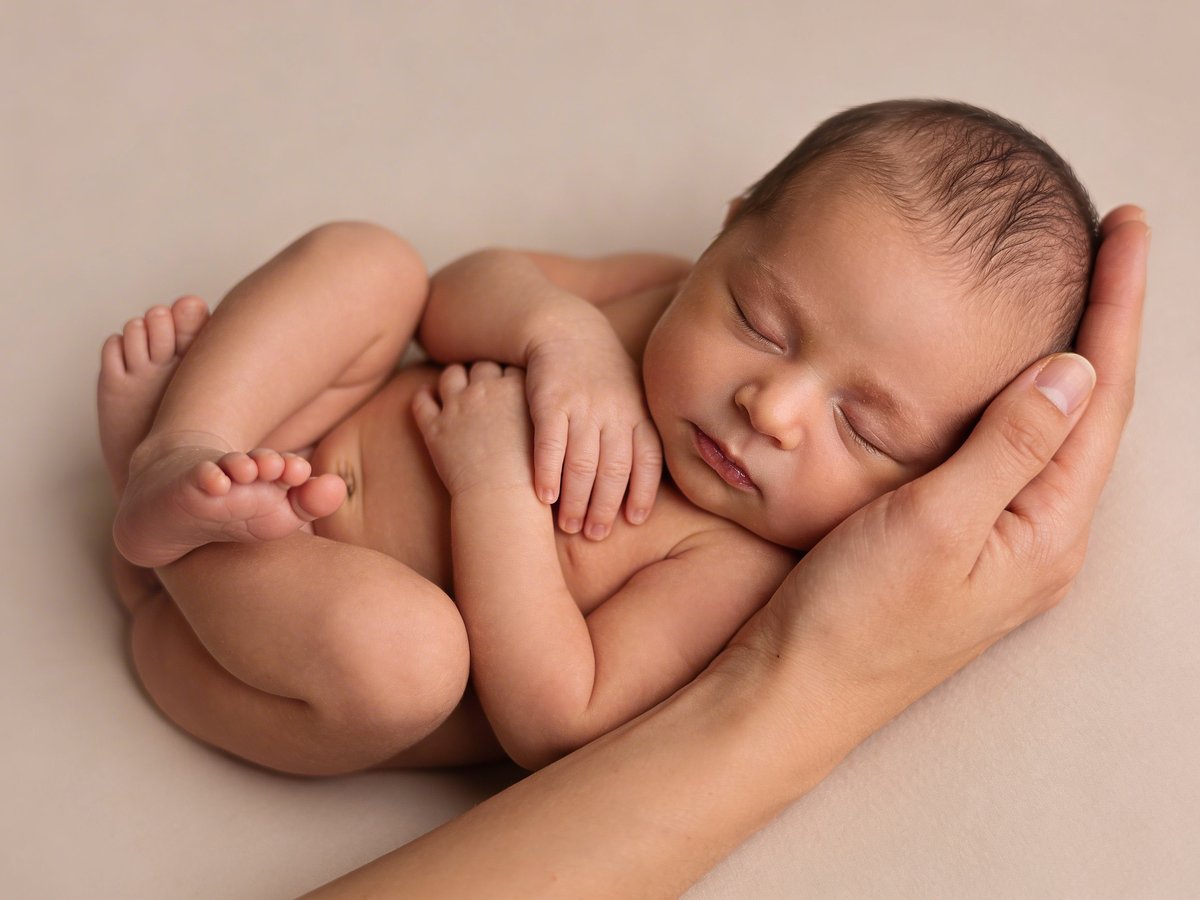
In the very first days of life, your baby retains the soft, natural flexibility of the womb. This brief window, typically the first 10 days, sometimes extending to 15, is when the classic cocooned newborn poses are achievable. The foetal curl, hands tucked beneath the chin, the compact bean shape: all of these work now because baby's joints are still naturally supple. Keep the room warmer than usual (26–28°C) so the heat encourages deep sleep and muscular relaxation.
Non-negotiable safety rules for this stage:
- Head and neck must be supported at every moment, the neck muscles cannot hold that weight independently yet
- An adult must be within arm's reach of the baby for the entire session, no exceptions
- Any image showing baby "suspended" or "balanced" alone is a composite: multiple frames merged in post-production with an adult supporting baby throughout every individual shot
- If your baby pushes back against a position, stiffening, fussing, or waking, abandon it. No image justifies discomfort
Weeks 2–12: natural positions take over
As neonatal flexibility fades after the first two weeks, the tightly curled newborn poses become impractical. Shift the focus to positions that work with your baby's changing body: lying on their back, on their side with a rolled blanket for support, or nestled in a parent's arms. This phase is about connection, those first wide-eyed gazes, the drowsy smiles, the way a tiny fist curls around a parent's finger. These moments are just as timeless as any formal pose.
3–6 months: expressions come alive
By three months, head control is improving, social smiling is well established, and your baby is starting to notice the world with genuine curiosity. Tummy time shots work beautifully at this stage (support the chest with a folded blanket), as do close-up portraits capturing that concentrated, wide-awake gaze. This is also an excellent moment for a dedicated 3-month photo session, the smiles are real, the poses are relaxed, and baby is still compact enough for intimate framing.
6–12 months: independence changes everything
Sitting independently, crawling, pulling up to stand, the second half of the first year throws open the creative doors. Babies at this age engage actively with their environment: they reach for things, react with surprise and delight, and express personality with unmistakable clarity. Photograph on soft surfaces (a thick rug, a low-pile blanket, or a well-padded sofa) and keep cushions positioned as silent safety nets nearby. For an age-by-age overview, our guide to baby photo sessions from newborn to 12 months covers every milestone in detail.
Camera settings that change as your baby grows
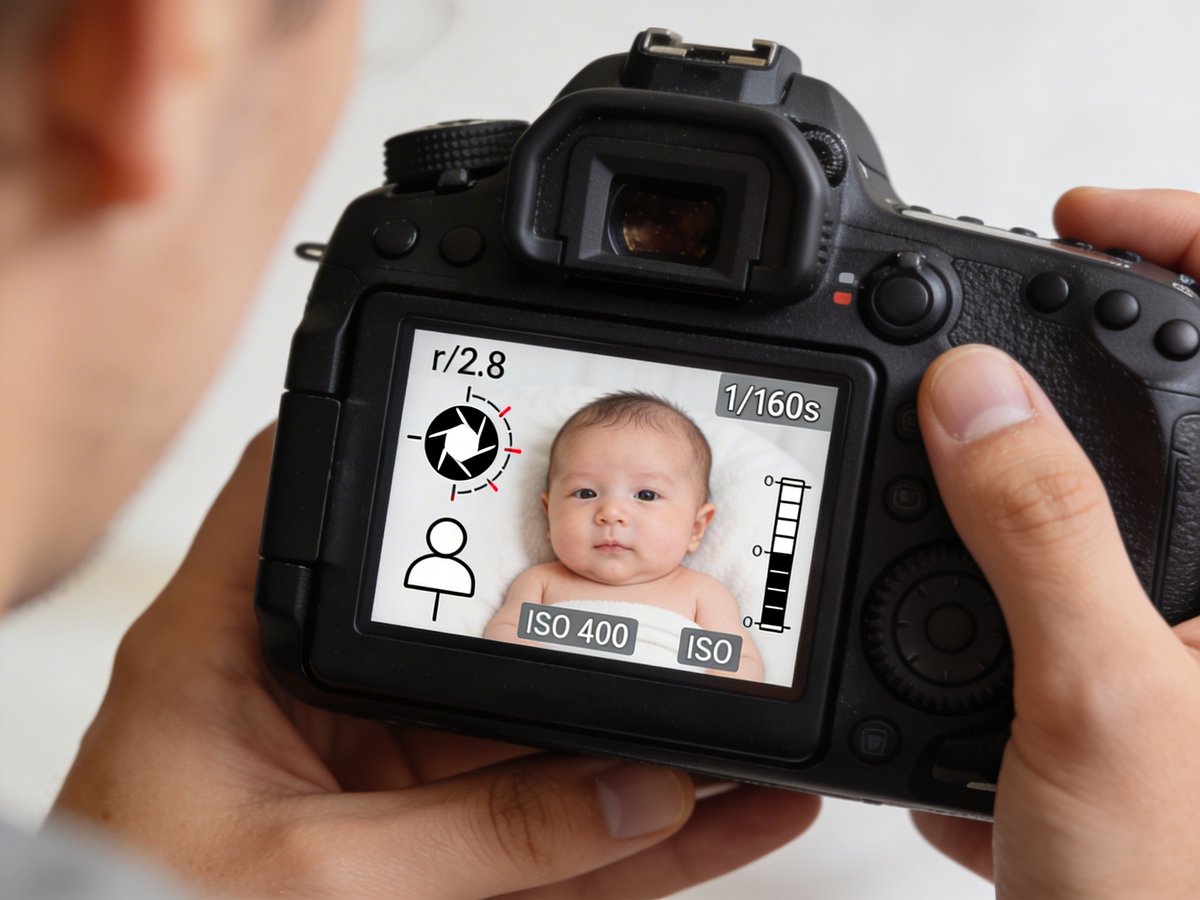
One of the most common frustrations parents experience when photographing their own baby is motion blur, that soft, slightly ghostly look that appears when shutter speed is too slow for the subject's movement. The solution is understanding how the right settings shift across your baby's development. Here's a reference guide to the settings professional photographers use at each stage.
| Age | Aperture | Shutter speed | ISO | Lens choice |
|---|---|---|---|---|
| 0–15 days (sleeping) | f/1.4 – f/2.0 | 1/60s – 1/100s | 100–200 | 50mm f/1.8 or 85mm f/1.4 |
| 1–3 months (alert) | f/2.0 – f/2.8 | 1/125s – 1/160s | 200–400 | 50mm f/1.8 or 35mm f/2.0 |
| 3–6 months (smiling) | f/2.0 – f/2.8 | 1/160s – 1/200s | 200–400 | 50mm f/1.8 or 24–70mm f/2.8 |
| 6–12 months (moving) | f/2.8 – f/4.0 | 1/200s – 1/320s | 400–800 | 24–70mm f/2.8 or 35mm f/1.4 |
Aperture priority: the working photographer's mode
Set your camera to aperture priority (marked A or Av on most bodies) and let the camera handle shutter speed while you control depth of field. Choosing a wide aperture, f/1.8 or f/2.0, does two useful things simultaneously: it blurs the background so that nothing competes with baby's face, and it lets in more light so you can keep the ISO low and the image clean. It's the mode that allows you to react instantly to a smile without fiddling with multiple dials.
Shutter speed: your defence against blur
A sleeping newborn gives you room to work at 1/60s. The moment your baby starts flailing those arms and turning their head, typically from around 6–8 weeks, you need at least 1/125s to freeze that movement. By six months, when they're lunging for anything within reach, 1/200s to 1/320s is the safer baseline. If achieving those speeds requires pushing ISO to 1600 or beyond, do it without hesitation. A sharp image at ISO 1600 is always preferable to a perfectly exposed blur.
Which lens actually earns its keep?
The 50mm f/1.8 is the lens that proves its value again and again, affordable, light, and capable of beautiful subject separation on a full-frame body. For close-up detail work (the crinkle of tiny toes, the curl of eyelashes), an 85mm f/1.4 is outstanding. If you want flexibility without changing glass, a 24–70mm f/2.8 zoom handles everything from full environmental shots to tight portraits without moving your feet, genuinely useful when baby has settled in one comfortable position. For further technical guidance, Canon Ireland's baby photography tips offer a solid foundation.
How to harness natural light in Irish homes
Natural newborn photography, using available window light rather than studio flash, is ideally suited to Ireland's climate. Ireland's famous soft, diffuse light, the result of Atlantic cloud cover that photographers in sunnier climates actually envy, is an asset in baby photography. You don't need to fight harsh direct sun; the natural diffusion does the work for you. What you need to do is position yourself correctly relative to the available light.
Window placement: the 45° rule
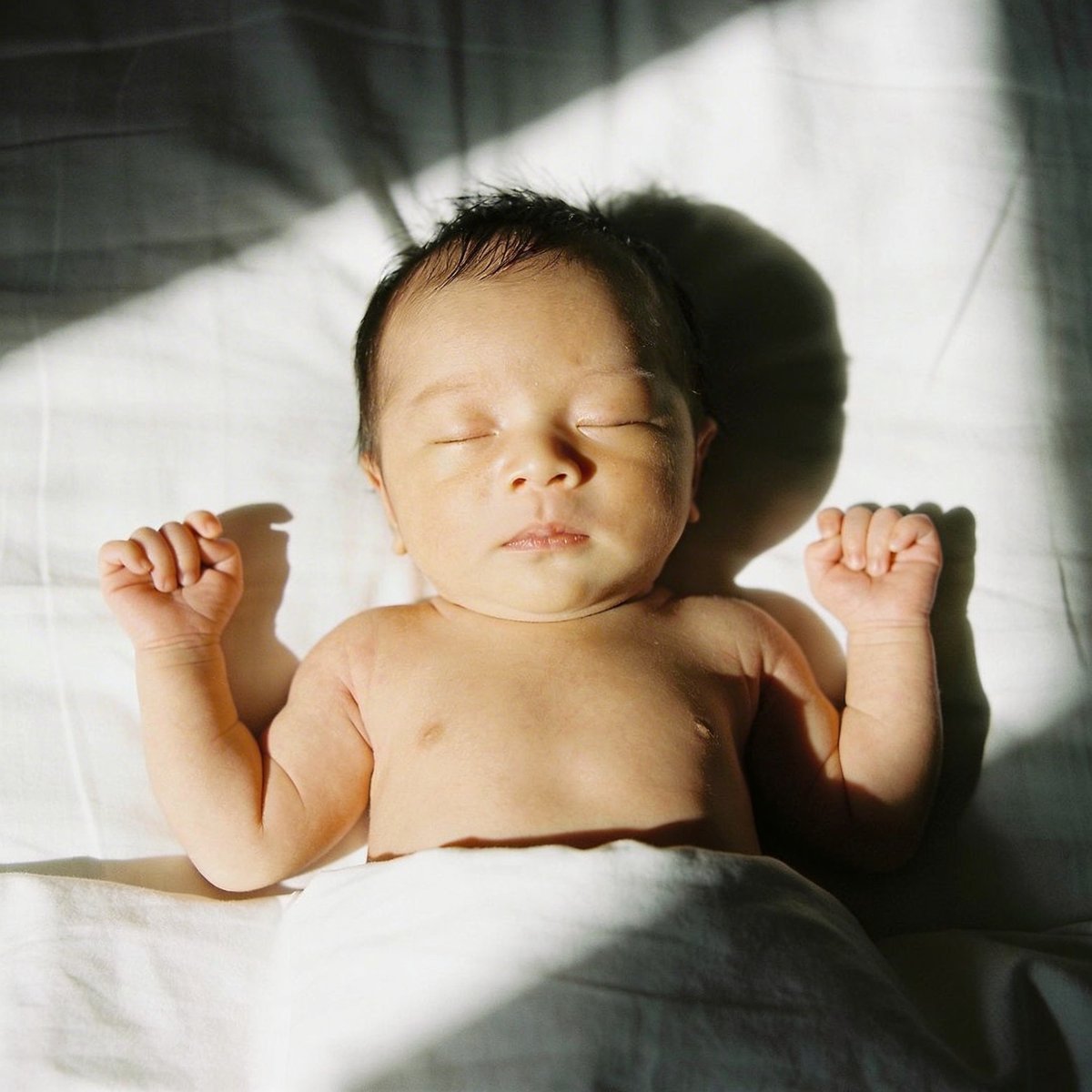
Draw an imaginary line from your baby to the nearest large window. Now position yourself so that line makes a 45° angle with your shooting axis. This geometry produces directional light that sculpts your baby's features with a gentle modelling effect, enough shape to create dimension, soft enough to avoid harsh shadows. Place baby roughly 1–2 metres from the glass. North-facing windows in Irish homes are ideal for longer sessions because the quality of light doesn't shift dramatically across the day.
A useful trick: if sunlight coming through the window is stronger than usual (it happens, even in Ireland), hang a single layer of white voile or a sheer curtain to diffuse it. On the shadow side of baby, a large piece of white card acts as a reflector, bouncing some of that window light back and preventing the underlit side from going too dark. It costs nothing and makes a visible difference.
Morning and late-afternoon light: when to shoot
The most flattering light for skin tones arrives early in the morning (8–10am) and again in the late afternoon (4–6pm), when the sun sits at a lower angle and the quality of light becomes warmer and less contrasty. Between roughly 11am and 3pm, direct sunlight is harder and more difficult to work with. If your sessions happen indoors by a window, this matters slightly less, but if any outdoor or conservatory work is planned, avoid the middle of the day.
Does flash harm babies' eyes?
The American Academy of Ophthalmology is clear: camera flash produces no proven harm to infant eyes. The light is brief and the intensity insufficient to cause damage. That said, direct flash pointed at a sleeping or resting newborn is still disruptive, the sudden bright light startles them, interrupts sleep cycles, and makes the session harder to manage. If artificial light is genuinely needed, bounce it off a ceiling or an adjacent white wall to create something diffuse and indirect. In practice, good window placement and the right ISO settings make flash unnecessary almost every time.
Composition, framing, and choosing the right props
Technical settings get your photos sharp and well-exposed. Composition is what makes them worth looking at for decades. These two elements, visual structure and the supporting cast of props and backdrops, work together to direct the viewer's eye towards what genuinely matters: your baby's face, hands, and unmistakable personality.
Get to their level
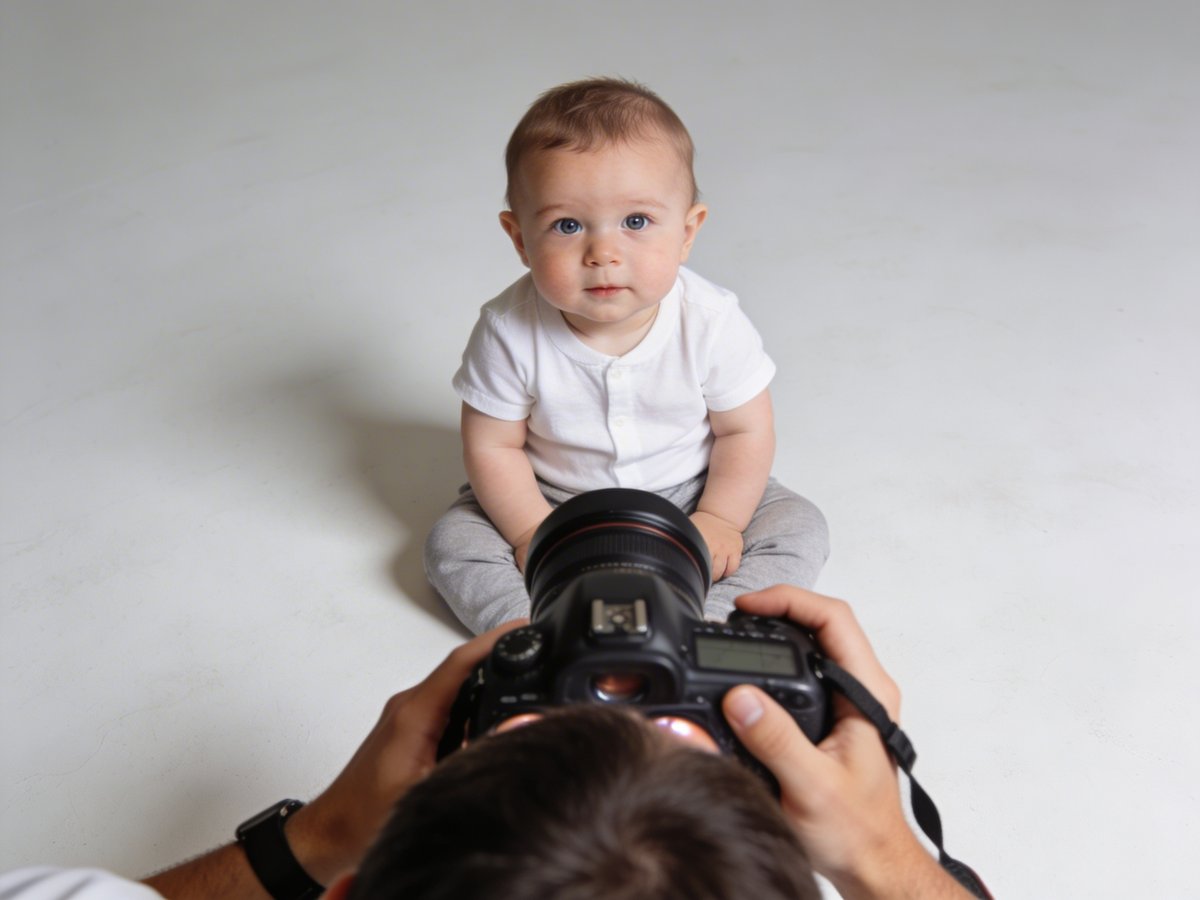
The most transformative single change most parents can make when photographing their own baby is simply to get lower. Shooting from adult standing height looks down on your subject, creating a perspective that reads as distance and diminishment. Position yourself at baby's eye level, flat on your stomach, kneeling, sitting cross-legged on the floor, and the relationship between viewer and subject shifts completely. The images feel intimate and connected rather than observed from above.
Composing within the frame
Place your baby's eyes on the upper horizontal third of the frame (enable the grid on your camera or phone screen if you haven't already). This single adjustment produces images that feel balanced and naturally pleasing without any formal training in why. Leave space in the direction your baby is looking, empty space in front of a gaze creates a sense of thought and openness; clipping the frame against it feels cramped.
Build variety with different shot types
- Environmental wide shot: baby within their setting (on a parent's bed, in the cot, on a rug in the living room), establishes context and tells a fuller story
- Three-quarter portrait: from roughly the chest up, capturing expression and movement of the arms and hands
- Tight face portrait: eyes filling most of the frame, works especially well once baby can hold your gaze at 6–8 weeks
- Detail shots: a whole session of nothing but feet, hands, ears, and eyelashes would not be excessive, these micro-portraits capture what disappears fastest
Props: how much is too much?
The most enduring baby photographs are usually the simplest. A few well-chosen props support the image without competing with it, the goal is always to make baby the undisputed subject, not a figure arranged among decorative objects.
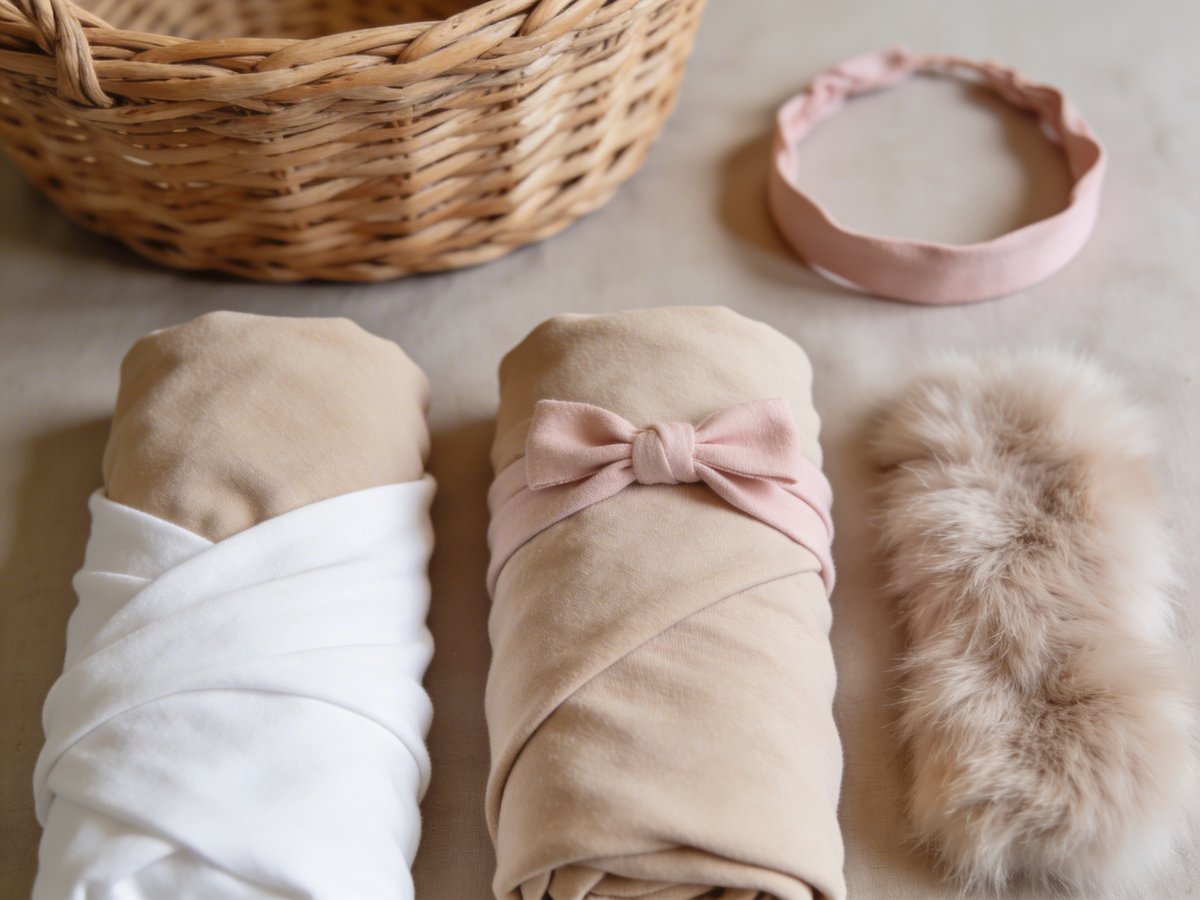
- Jersey stretch wraps: natural-toned (oatmeal, ivory, soft grey) jersey fabric is the single most versatile prop in baby photography, it wraps securely, drapes beautifully, and photographs in any light
- Textured blankets and faux fur: add depth and tactile richness to otherwise flat surfaces
- Soft headbands and knitted bonnets: a touch of detail without overwhelming a tiny face
- Baskets and crates: classic newborn prop, always place weight in the base to prevent tipping, and never leave a baby in a raised container unattended
Colour palette: what ages well
Stick to muted, neutral tones: off-white, warm grey, dusty rose, pale sage, linen. These sit harmoniously against most skin tones, photograph cleanly in natural light, and, crucially, they won't date. A neon yellow backdrop looks sharp in 2025 and jarring in 2035. Soft neutrals look timeless in any decade.
Frequently asked questions about baby photography in Ireland
What camera settings work best for photographing a moving baby?
Switch to burst mode and set your shutter speed to at least 1/200s, 1/320s for very active crawlers and almost-walkers. Enable continuous autofocus (AF-C on Nikon/Sony, AI Servo on Canon) so the camera tracks movement rather than locking onto a single point. Aperture priority mode lets you keep control of depth of field while the camera automatically adjusts the shutter. If the resulting shutter speed drops below your target, raise the ISO, grain is always preferable to blur when it comes to capturing something irreplaceable.
Is flash safe to use around babies and newborns?
According to the American Academy of Ophthalmology, brief camera flash is not harmful to infant eyes. The concern isn't safety, it's the practical disruption. A sudden flash wakes a sleeping newborn, interrupts the drowsy, settled state that newborn poses depend on, and often triggers distress that takes time to settle. Work with natural window light, a wide aperture, and a willingness to push ISO, and you'll rarely need flash at all. If you must use it, bounce it off a ceiling or wall rather than pointing it directly at baby.
How much does a newborn photography session cost in Ireland?
Pricing in Ireland typically separates the session fee from the products you choose. Session fees in Dublin generally run from €99 to €125 for a booking deposit, with full package investments starting at around €500–€600 for a collection of prints and digital images, rising to €1,000–€2,000+ for premium packages including albums and canvas prints. Photographers in Cork, Galway, and Limerick tend to be priced slightly lower than Dublin. For a full breakdown, read our guide to baby photographer prices in Ireland 2026.
When is the best time to book a newborn session?
Book during your pregnancy, ideally in the second trimester. The newborn window (first 5–15 days) is the only time curled, cocooned poses are achievable, and good Irish photographers fill their books months in advance. Book a provisional date around your due date and confirm once baby arrives. Most photographers build flexibility into their newborn booking system to account for early or late arrivals.
How do you photograph a newborn in a curled pose safely?
The foetal-style curled pose is only possible in the first 10–15 days, when neonatal joint flexibility persists. Work only when baby is in a deep sleep, typically 20–30 minutes after they first fall asleep, always with one hand supporting the head and another beneath the hips. The room must be genuinely warm (26–28°C) to encourage muscular relaxation. Any composite pose, where baby appears suspended or self-supporting, is multiple frames merged in editing, with an adult's hands supporting the baby throughout every individual shot. A photographer who suggests otherwise is cutting corners on safety.
Can you photograph a sleeping baby without disturbing them?
Yes, with the right approach. Use your camera's electronic or silent shutter if available, work entirely by natural window light (no flash triggers), and move slowly and deliberately. Continuous white noise played at a consistent low volume throughout the session does more than people expect, it masks the small ambient sounds that would otherwise interrupt light sleep. Avoid sudden room temperature changes, and keep a warm blanket ready to cover baby between position changes.
Every month passes faster than the last
What makes baby photography genuinely irreplaceable is its relationship with time. The expressions, proportions, and gestures that define your baby at eight days old are gone at eight weeks. The way they finally push up on their arms to look around at four months is gone by six. These aren't just photographs, they're the only record you'll ever have of moments that existed once and then never again.
Getting the most from a professional session means understanding what your photographer is actually doing: reading light, reading your baby's mood, making a hundred small technical decisions, all in service of producing images that are still worth looking at when your child is sixteen. The more you understand their craft, the better you can prepare and the more you'll value the results.
Print the best ones. Not all of them, but the best ones, in a format that survives a hard drive failure. A printed album sits on a shelf, gets opened spontaneously, gets shown to relatives, gets discovered by your child years later. The folder on your laptop does none of those things.
With 54,062 births registered across Ireland in 2024 (source: CSO), every family in Leinster, Munster, Connacht, and Ulster has the same precious, fleeting first year. Our directory of Irish baby photographers covers Dublin, Cork, Galway, Limerick, and Waterford, with portfolios, pricing, and verified reviews so you can find the right photographer with confidence.
Find a baby photographer across Ireland
Explore portfolios, read verified reviews, and compare packages from specialist baby photographers throughout the island.
See all photographers →More guides for Irish families
- How to choose a baby photographer in Ireland, complete guide 2026
- Baby photo sessions by age: from newborn to 12 months
- Baby photographer prices in Ireland 2026: what to expect
- 3-month baby photo session: how to prepare and what to expect
- Maternity photoshoot: the best time to book and how to prepare
- Baby passport photo: complete Irish guide 2026

